
Our Commitment to Safe Sport & Safe Sport Reporting
Safe Sport is a collective responsibility. By reporting concerns of maltreatment in sport, you are contributing to building a safer sport environment.
Sport for Life is committed to creating an environment free from all forms of maltreatment and treating all people with dignity and respect. Our two main priorities are to improve the quality of sports and develop physical literacy. In order to achieve that sport and physical activity need to be safe.
Quality sport and physical activity, guided by the three P’s, good people, good programs, and good places, are inherently preventative and foundational approaches to safe sport. When caring, knowledgeable, and ethical leaders, coaches, and officials deliver well-designed, developmentally appropriate, and participant-centered programs in environments that are safe, inclusive, welcoming, and accessible, the conditions that can contribute to abuse, harassment, and maltreatment are reduced.
Good people help ensure that relationships, decisions, and practices prioritize participant well-being.
Good programs are intentionally structured to engage, support, and appropriately challenge participants at every stage of development. Good places foster safety, belonging, and respect for all.
Together, these elements help create a culture where safety is built into the everyday delivery of quality sport and physical activity, reinforcing Sport for Life’s belief that quality sport and physical activity environments naturally lead to safer experiences and that prevention is embedded in the fabric of both quality sport and physical activity itself.
When Sport for Life refers to safe sport, we mean the design, development, delivery, evaluation, and knowledge mobilization of quality sport and physical literacy experiences that consider and strive to ensure that each participant feels physically, psychologically, emotionally, and culturally safe.
To Sport for Life, ‘safe’ means being safe and feeling safe and defines safety in four categories:
Social-Emotional Safety
Social-emotional safety stresses creating an environment where participants feel secure and supported in expressing their emotions, thoughts, and concerns without fear of judgment, prejudice, ridicule, or retribution. Feeling secure and trusting those around you enough to be vulnerable, courageous and authentic. This promotes their overall well-being and mental health.
Psychological Safety
Psychological safety focuses on cultivating an atmosphere where participants, coaches, leaders, community members, families, officials, and others feel comfortable and empowered to take risks, share their ideas, ask questions, and engage in open, honest communication without fear of negative consequences or retaliation.
Physical Safety
Physical safety refers to reducing the risk of injuries, concussion management, appropriate and progressive return to activity after injury, proper access to and use of equipment, etc. Creating physical environments that are designed for all types of participants is also a consideration for physical safety. Protecting participants from any form of physical harm, injury, violence, or abuse is central to physical safety.
Cultural Safety
Cultural safety emphasizes creating an inclusive and respectful environment that recognizes and embraces the diversity of participants, considering their cultural backgrounds, values, and beliefs, and actively working to prevent any form of discrimination, prejudice, or bias based on cultural differences.
How To Report
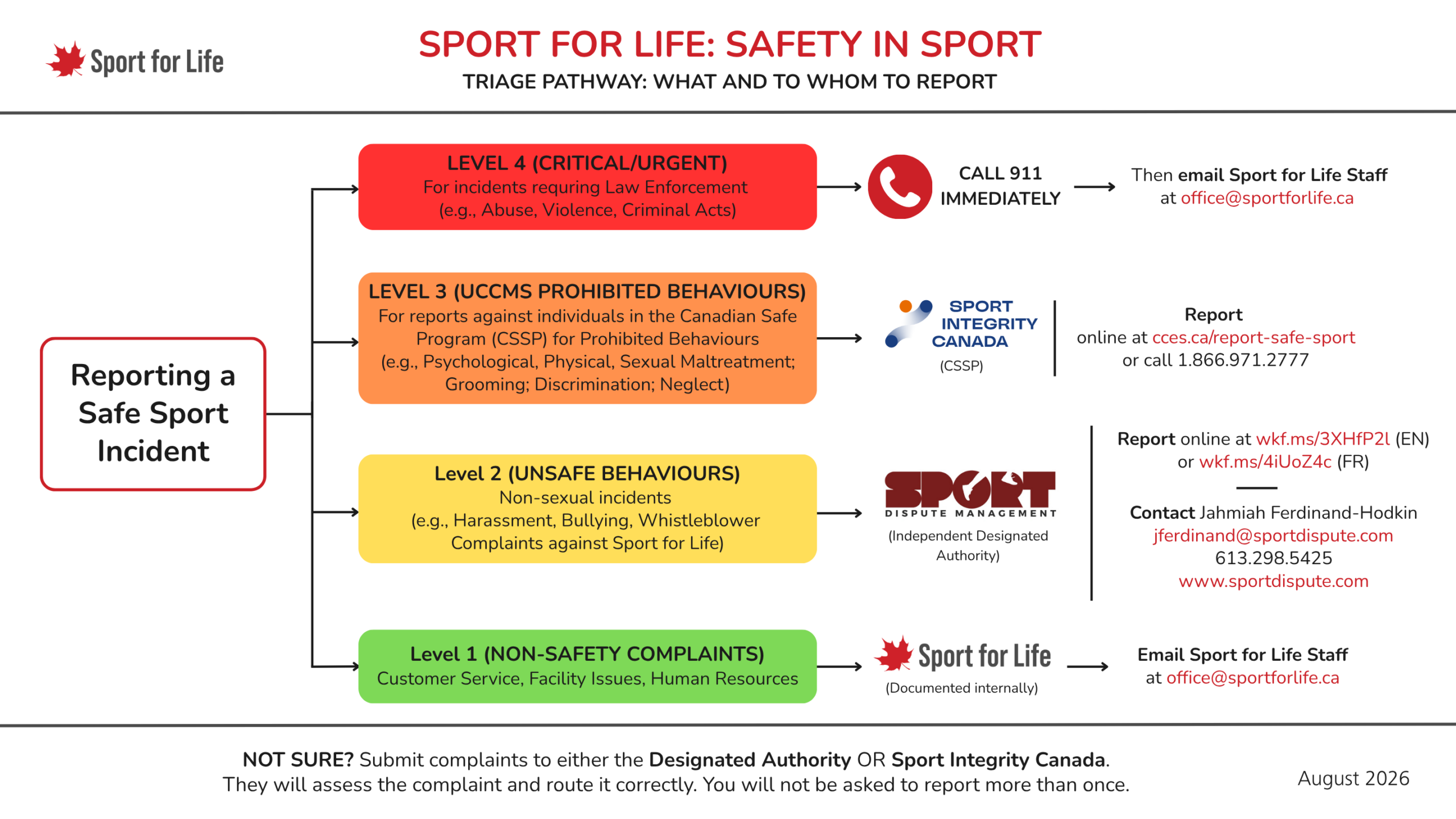
If you need to report an incident, concern, or complaint related to a Sport for Life event, program, activity, participant, or representative, please review the reporting options below. The appropriate pathway depends on the nature and urgency of the incident or concern.
Level 1
If you have a non-safety complaint about customer service, facility issues or human resource issues = contact office@sportforlife.ca
Level 2
To report a non-sexual unsafe behaviour, including harassment, bullying, or whistleblower complaints against Sport for Life = Report through Sport Dispute Management online at these forms: https://wkf.ms/3XHfP2l for ENG and https://wkf.ms/4iUoZ4c for FR or by contacting Jahmiah Ferdinand-Hodkin at ferdinand@sportdispute.com at Sport Dispute Managerment or 613-298-5425.
Level 3
To report prohibited behaviour, including psychological maltreatment, physical maltreatment, neglect, sexual maltreatment, grooming, boundary transgression, discrimination, subjecting a participant to the risk of maltreatment, aiding and abetting, failing to report possible maltreatment, intentionally reporting a false allegation, or interference with or manipulation of a process = Report online by visiting https://sportintegrity.ca/report-safe-sport or by phone 1-866-971-2777 (toll free)
Level 4
To report a critical or urgent incident, including abuse, violence or criminal acts = Call 911, and inform Sport for Life at office@sportforlife.ca.
For More Information
- Sport for Life’s Safety In Sport Policy and the Complaint and Dispute Resolution Procedures. (link directly to the Policies and Procedures page) https://sportforlife.ca/policies/
- Canadian Safe Sport Program (CSSP) e-learning courses on rules and maltreatment: https://sportintegrity.ca/safe-sport-e-learning. Please note that Sport for Life can distribute an invitation that includes a link to sign up, instructions, and a code to access the course.
- Anti-doping
- Child Protection
- Concussion
- Injury prevention
- Respect in Sport
- Safe Sport Coaches Training