One framework, every stage of life.
Long-Term Development
How Sport for Life built the framework that guides Canadians through every stage of sport and physical activity.
What Is Long-Term Development
Sport for Life built Canada's Long-Term Development in Sport and Physical Activity (LTD) framework, growing out of the original Long-Term Athlete Development (LTAD) framework we created in 2005. It's now a world-leading approach to participant development, guiding people from their first experience in sport all the way to Active for Life, and for some, to the highest competitive level.
LTD is for everyone, not just people chasing high performance. It looks at mental, physical, social, and technical-tactical development together, so every stage stays developmentally appropriate for the person in it. The goal is the same in everything we do: build high-performing humans through sport, not just high-performing athletes.
From Triangle to Rectangle
Canada's sport system used to work like a pyramid. Lots of participants started at the bottom, but as competition increased, fewer and fewer remained, until only a small group made it to the top. Many who got there did so through harsh, unsupportive environments, with no real plan for what came next once their playing career ended.
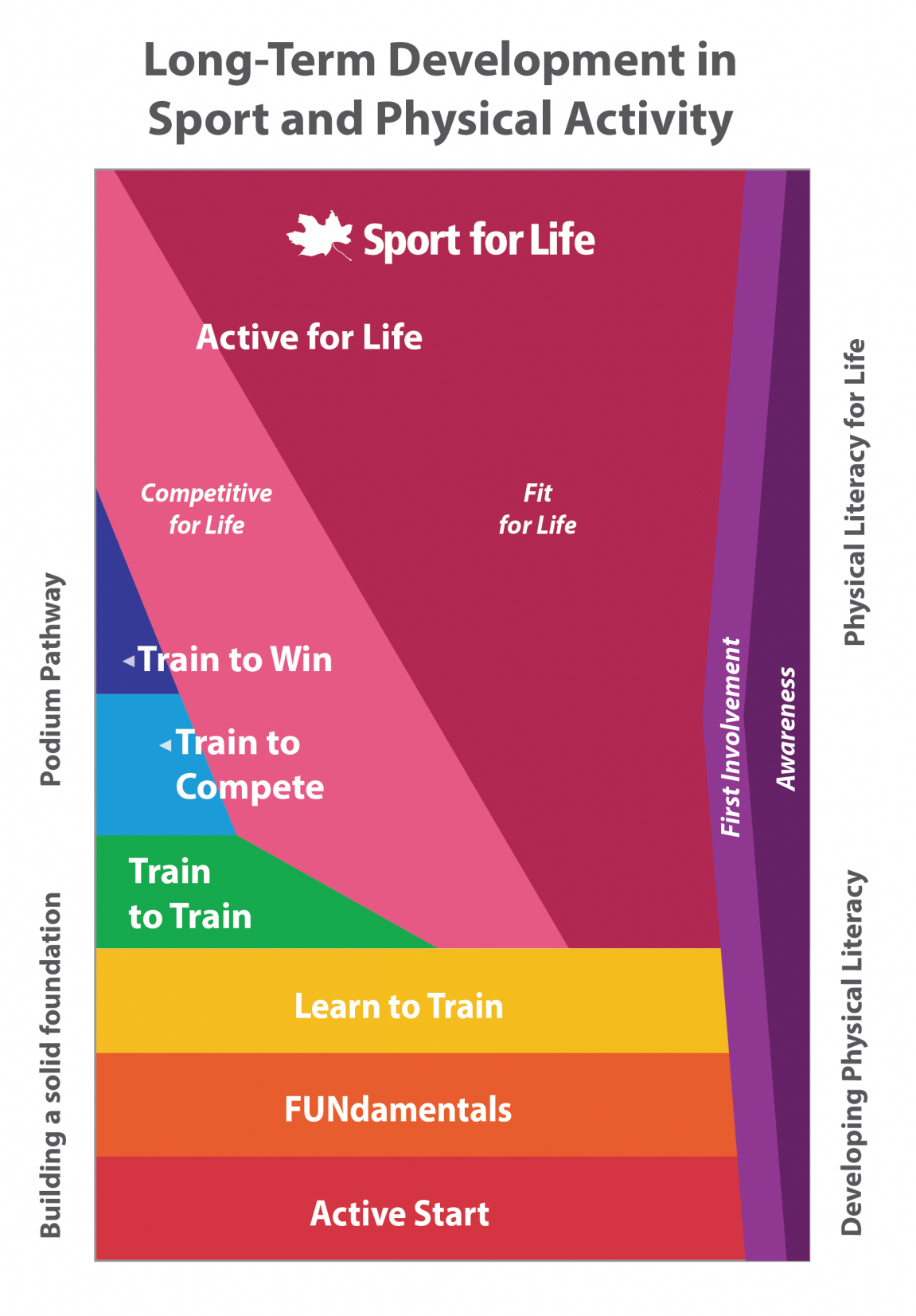
Sport for Life helped shift that pyramid into a rectangle: a system where everyone has a place in sport and physical activity at every stage of life, not just those who make it to the top.
That system now moves through nine stages: Awareness, First Involvement, Active Start, FUNdamentals, Learn to Train, Train to Train, Train to Compete, Train to Win, and Active for Life.
Some people are working toward competition. Others want to build skills, stay social, or come back to sport later in life. The rectangle makes room for both, and treats lifelong participation as a real goal, not a fallback for people who didn't make it to the top.
How We Bring This to Life
We work with partners at every level, from national organizations to local communities, to put this framework into practice. We build the tools and guidance that help organizations deliver quality experiences at each stage, and help individuals and families find the right entry point for where they are.
Awareness
Introducing sport and physical activity to everyone, especially underserved and new participants, through schools, families, and community organizations.
First Involvement
Making a person's first experience in sport welcoming, fun, and positive, so they enter the system with confidence.
Active Start
Making movement part of a young child's daily routine, through play, family, and quality early programs.
FUNdamentals
Building physical literacy, confidence, and fundamental movement skills through fun, inclusive multisport experiences.
Learn to Train
Developing real skills and motivation, with a continued focus on multisport experiences and physical literacy.
Train to Train
Introducing focused training and meaningful competition, guided by biological development rather than age alone.
Train to Compete
Preparing athletes for higher-level competition, while still protecting their wellbeing and stage-appropriate progress.
Train to Win
Supporting athletes pursuing excellence through aligned, specialized training and competition systems.
Active for Life
Treating lifelong participation as a real goal, with support to stay active, engaged, and connected at every age.
Every stage responds to more than a person's age. Chronological age gives a rough starting guideline, but LTD 3.0 also looks at biological markers, like the timing of a growth spurt, how much time someone has spent developing a skill, and whether they're actually ready to move forward. Two people born the same year can be at very different stages of development, so building pathways around real readiness, not just birth year, is what makes this framework work.
What Is the LTD Resource?
Long-Term Development in Sport and Physical Activity is the third version of Canada's athlete development framework, first built in 2005. It's evidence-informed and designed for every child, youth, and adult, covering individual development, training, competition, coaching, facilities, and how the whole sport system fits together.
The framework has three goals: build physical literacy, support the pursuit of excellence, and help people stay active for life. At its core is one simple belief: every participant deserves good programs, in good places, delivered by good people.